Weighted Ensemble#
In this notebook we will see how easy it is to implement the weighted ensemble method using asyncmd. The implementation below is limited to bins along one CV but supports unequal binsizes. It can also be used with any asyncmd engine and TrajectoryFunctionWrapper (this means you could run this on a cluster simply by using slurm enabled versions of the engine and ensemble CV). We will test/showcase our implementation using the local gromacs engine on the example of capped alanine dipeptide (as always), but it is easy to use a different molecular system and ensemble CV.
For an introduction to the weighted ensemble method see e.g. “The “weighted ensemble” path sampling method is statistically exact for a broad class of stochastic processes and binning procedures” by Zhang, Jasnow and Zuckerman (2010, J. Chem. Phys.; https://aip.scitation.org/doi/10.1063/1.3306345).
This notebook should be run on a multi-core workstation, otherwise you will have a very long coffee break and a very hot laptop. However, note: With alanine dipeptide this actually runs faster with a non-GPU-capable gromacs version (due to the overhead incurred for initializing so many simulations on the GPU and because on the GPU all simulations will request/compete for all resources of the same GPU, while on the CPU it is easy to limit the number of threads per simulation, making the many simulation play nicer together with each other). This should not be true anymore even for moderately sized systems, so if you use this with another molecular system and have a GPU, make sure to try to use it.
Required knowledge/recommended reading: This notebook assumes some familiarity with the gromacs engine (see the notebooks in the 01_engines/gromacs directory) and the TrajectoryFunctionWrappers (see notebooks PyTrajectoryFunctionWrapper.ipynb and/or SlurmTrajectoryFunctionWrapper.ipynb).
%matplotlib inline
import os
import time
import tqdm.auto as tqdm
import matplotlib.pyplot as plt
import numpy as np
import asyncio
import asyncmd
import asyncmd.gromacs as asyncgmx
import asyncmd.trajectory as asynctraj
Could not initialize SLURM cluster handling. If you are sure SLURM (sinfo/sacct/etc) is available try calling `asyncmd.config.set_slurm_settings()` with the appropriate arguments.
Define weighted ensemble simulation classes#
We define one user-facing weighted ensemble class that keeps track of the history and takes care of splitting/pruning of the single simulations and which handles most of the bookkeeping. The actual molecular dynamics simulations are handled by the lightweight walker class which just propagates the trajectories on request and keeps track of its own history of trajectories and associated weights.
The full implementation including (extensive) comments is just 220 lines of code, I recommend having a quick read over it. In any case this shows how easy it is to implement more complex dynamic path based sampling schemes using asyncmd. While the implementation is fairly general (i.e. you can easily use it with different molecular systems and ensemble CVs) and can be run on a cluster, please have a list at the points below before using it in a production setting.
If you implement any of the points below (or anything else that is useful) please feel free to submit a pull request to let everybody profit from your hard work. :)
What is missing for a “good” implementation:
Better/more history/logging and make the history and sampler class saveable for analysis and restarts. One can (probably) just pickle the sampler object, but it would also be good to keep track of the history of trajectories in the filesystem. For this one would probably need to write out the weights for each trajectory part next to the trajectories and symlink the parent walkers folder when splitting a walker. Also maybe write to the filesystem after which round a walker was pruned.
Currently the implementation assumes gromacs engines, because we hardcode xtc/trr trajectory output and write the starting configuration for new trajectories as trr. This means that in the current state this will only work with
GmxEngineandSlurmGmxEngineengine classes. While it is easy to adopt it to any other engine by changing the hardcoded formats to some other format it would be nice to have a general solution working for all engines (to output low precision/compressed trajectories except for the last and first frames).2d/Nd generalization
…
class EnsembleWalker:
    traj_deffnm = "WE_walker"

    def __init__(self, workdir, engine_cls, engine_kwargs, starting_configuration, nsteps_per_part, current_weight, walker_id, parent_walker=None):
        self.workdir = workdir
        self.engine_cls = engine_cls
        self.engine_kwargs = engine_kwargs
        self.starting_configuration = starting_configuration
        self.nsteps_per_part = nsteps_per_part
        self.current_weight = current_weight
        self.walker_id = walker_id
        if parent_walker is not None:
            self.parent_walker_id = parent_walker.walker_id
            self.current_traj = parent_walker.current_traj
        else:
            self.current_traj = None

        self._initialized = False
        self._engine = None
        self.trajectories = [] # list of tuples: (traj, weight)

    async def _prepare(self):
        self._engine = self.engine_cls(**self.engine_kwargs)
        await self._engine.prepare(starting_configuration=self.starting_configuration,
                                   workdir=self.workdir,
                                   deffnm=self.traj_deffnm)

    async def make_traj(self):
        if not self._initialized:
            await self._prepare()
            self._initialized = True
        return_traj = await self._engine.run_steps(nsteps=self.nsteps_per_part, steps_per_part=True)
        self.current_traj = return_traj
        self.trajectories += [(return_traj, self.current_weight)]
        return return_traj, self.current_weight


class WeightedEnsemble_1d:
    walkerdir_prefix = "walker_"

    def __init__(self, workdir, engine_cls, engine_kwargs, ensemble_cv, bin_edges, nsteps_per_round, n_traj_target, verbose=False):
        self.workdir = workdir
        self.engine_cls = engine_cls
        self.engine_kwargs = engine_kwargs
        self.ensemble_cv = ensemble_cv
        self.bin_edges = np.array(bin_edges)
        self.nsteps_per_round = nsteps_per_round
        self.n_traj_target = n_traj_target
        self.verbose = verbose

        self._rng = np.random.default_rng()
        self.walkers = {} # dict of all walkers that ever lived, keys are the ids (as int!)
        self.active_walker_ids = [] # list of all active walker ids
        self._walker_id_count = 0  # this is just a continuously increased ID, not the index of the walker (we use it to have unique dirnames)
        self._walker_ids_by_bins = [[] for _ in range(self.n_bins)]
        self.history = [] # we will have a list of dicts for each round in here
                          # with dict keys: "traj", "weight", "walker_id",

    @property
    def n_bins(self):
        return len(self.bin_edges) - 1

    async def get_bin_idxs_for_traj(self, traj):
        cv_vals = await self.ensemble_cv(traj)
        bin_idxs = np.digitize(cv_vals, self.bin_edges) - 1
        return bin_idxs

    async def _sort_walkers_into_bins(self):
        self._walker_ids_by_bins = [[] for _ in range(self.n_bins)]
        bin_idxs_by_walker = await asyncio.gather(*(self.get_bin_idxs_for_traj(self.walkers[w_id].current_traj)
                                                    for w_id in self.active_walker_ids))
        for walker_id, current_bin_idxs in zip(self.active_walker_ids, bin_idxs_by_walker):
            self._walker_ids_by_bins[current_bin_idxs[-1]] += [walker_id]

    def _create_walker(self, starting_configuration, starting_weight, walker_dir, walker_id, parent_walker):
        # Note: we expect walkerdir to exist already (this way we can write starting_configuration to that dir already)
        #walker_wdir = os.path.join(workdir, f"{self.walkerdir_prefix}{self._walker_count}")
        self.walkers[walker_id] = EnsembleWalker(workdir=walker_dir,
                                                  engine_cls=self.engine_cls,
                                                  engine_kwargs=self.engine_kwargs,
                                                  starting_configuration=starting_configuration,
                                                  nsteps_per_part=self.nsteps_per_round,
                                                  current_weight=starting_weight,
                                                  walker_id=walker_id,
                                                  parent_walker=parent_walker,
                                                  )
        self.active_walker_ids += [walker_id]

    async def _split_walker(self, walker_id, new_walker_ids):
        # this splits the walker with walker_id as many times as we get new_walker_ids,
        # reduce the weight of the old walker
        self.walkers[walker_id].current_weight /= len(new_walker_ids) + 1  # we have n_new + 1 old replica of the walker
        # keep track of the parent walker (id)
        parent_walker = self.walkers[walker_id]
        for new_walker_id in new_walker_ids:
            walker_dir = os.path.join(self.workdir, f"{self.walkerdir_prefix}{new_walker_id}")
            os.mkdir(walker_dir)
            frame_extractor = asynctraj.convert.NoModificationFrameExtractor()
            # make sure we use the full precision trr trajectory for restart even if the engine output traj is xtc
            # Note: this of course only works if gromacs writes both trajectories, i.e. we have to make sure that
            #       the number of total steps per round is divisible by nstxout and nstvout when setting up the mdp options
            if parent_walker.current_traj.trajectory_files[0].lower().endswith(".trr"):
                traj_in = parent_walker.current_traj
            elif parent_walker.current_traj.trajectory_files[0].lower().endswith(".xtc"):
                traj_in = asyncmd.Trajectory(trajectory_files=parent_walker.current_traj.trajectory_files[0][:-3] + "trr",
                                             structure_file=parent_walker.current_traj.structure_file,
                                             )
            starting_configuration = frame_extractor.extract(outfile=os.path.join(walker_dir, "initial_configuration.trr"),
                                                             traj_in=traj_in,
                                                             idx=-1,
                                                             )
            # create the new walker with the new weight
            self._create_walker(starting_configuration=starting_configuration,
                                starting_weight=parent_walker.current_weight,
                                walker_dir=walker_dir,
                                walker_id=new_walker_id,
                                parent_walker=parent_walker,
                                )

    async def _split_bin(self, bin_idx):
        # splits walkers in given bin (if needed)
        # returns the walker_ids of the created walkers
        walker_ids = np.array(self._walker_ids_by_bins[bin_idx])
        n_walkers_to_create = self.n_traj_target - len(walker_ids)
        if len(walker_ids) > 0 and n_walkers_to_create > 0:
            # need to have at least one (but less than n_traj_target) walker in the bin to (need and be able to) split
            weights = np.array([self.walkers[w_id].current_weight for w_id in walker_ids])
            probs = weights / np.sum(weights)
            walker_to_split_id = self._rng.choice(walker_ids, p=probs)
            # get the new walker_ids and update our id counter
            new_walker_ids = [w_id for w_id in range(self._walker_id_count, self._walker_id_count + n_walkers_to_create)]
            self._walker_id_count += n_walkers_to_create
            if self.verbose > 1:
                print(f"Created {len(new_walker_ids)} new walkers (with ids {new_walker_ids}) by "
                      + f"splitting walker with id {walker_to_split_id} in bin [{self.bin_edges[bin_idx]}, {self.bin_edges[bin_idx + 1]}]."
                      )
            await self._split_walker(walker_id=walker_to_split_id,
                                     new_walker_ids=new_walker_ids,
                                     )
            return new_walker_ids
        else:
            return []

    async def _prune_bin(self, bin_idx):
        # prunes a given bin (if needed)
        # returns a list with the walker ids of the walkers that got pruned
        walker_ids = np.array(self._walker_ids_by_bins[bin_idx])
        n_walkers_to_create = self.n_traj_target - len(walker_ids)
        if n_walkers_to_create < 0:
            # pruning/merging time!
            # Note: n_walkers_to_create is negative!
            weights = np.array([self.walkers[w_id].current_weight for w_id in walker_ids])
            sort_idxs = np.argsort(weights)
            sorted_weights = weights[sort_idxs]
            sorted_weights = sorted_weights[:(-n_walkers_to_create + 1)]  # keep only the weights of walkers we consider for pruning
            weight_sum = np.sum(sorted_weights)
            sorted_probs = sorted_weights / weight_sum
            sorted_walker_ids = walker_ids[sort_idxs]
            # we prune the -n_walkers_to_create walkers with the lowest weights
            # and draw at random which walkers history to keep
            walker_ids_to_potentially_prune = sorted_walker_ids[:(-n_walkers_to_create + 1)]
            walker_id_to_merge_with = self._rng.choice(walker_ids_to_potentially_prune, p=sorted_probs)
            # create a list of walker ids for the walkers we chose to prune
            walker_ids_to_prune = list(walker_ids_to_potentially_prune)
            walker_ids_to_prune.remove(walker_id_to_merge_with)
            # update the weight of the surviving walker
            self.walkers[walker_id_to_merge_with].current_weight = weight_sum
            # and set the weights of the pruned walkers to zero
            for prune_w_id in walker_ids_to_prune:
                self.walkers[prune_w_id].current_weight = 0
            if self.verbose > 1:
                print(f"Pruned {-n_walkers_to_create} walkers from ids {walker_ids_to_prune} by merging it with walker id {walker_id_to_merge_with}"
                      + f" in bin [{self.bin_edges[bin_idx]}, {self.bin_edges[bin_idx + 1]}].")
            return walker_ids_to_prune
        else:
            return []

    async def split_and_prune_all_bins(self):
        await self._sort_walkers_into_bins()  # make sure our walker to bin mapping is up to date
        # first split (where needed)
        created_walkers = await asyncio.gather(*(self._split_bin(bin_idx) for bin_idx in range(self.n_bins)))
        # and prune (where needed)
        pruned_walkers = await asyncio.gather(*(self._prune_bin(bin_idx) for bin_idx in range(self.n_bins)))
        # remove the pruned walkers from active walker id list
        for to_prune_ids in pruned_walkers:
            for w_id in to_prune_ids:
                self.active_walker_ids.remove(w_id)
        if self.verbose:
            n_created = sum(len(created_per_bin) for created_per_bin in created_walkers)
            n_pruned = sum(len(pruned_per_bin) for pruned_per_bin in pruned_walkers)
            print(f"Created a total of {n_created} and pruned a total of {n_pruned} walkers.")

    async def run_one_round(self):
        # run all walkers for one round and then check for split and prune possibilities
        results = await asyncio.gather(*(self.walkers[w_id].make_traj() for w_id in self.active_walker_ids))
        result_dict_list = []
        for walker_id, (traj, weight) in enumerate(results):
            result_dict_list += [{"traj": traj, "weight": weight,
                                  "walker_id": walker_id,
                                  }]
        self.history += [result_dict_list]
        # merge and split as appropriate
        await self.split_and_prune_all_bins()

    async def run_n_rounds(self, n_rounds):
        # run all walkers for n_rounds
        for _ in tqdm.tqdm(range(n_rounds)):
            await self.run_one_round()

    def create_walker(self, starting_configuration, weight=1):
        new_walker_id = self._walker_id_count
        self._walker_id_count += 1
        walker_dir = os.path.join(self.workdir, f"{self.walkerdir_prefix}{new_walker_id}")
        os.makedirs(walker_dir)
        # create the new walker with the new weight
        self._create_walker(starting_configuration=starting_configuration,
                            starting_weight=weight,
                            walker_dir=walker_dir,
                            walker_id=new_walker_id,
                            parent_walker=None,  # this walker has no parent
                            )
Setup and run weighted ensemble simulation of capped alanine dipeptide#
To profit the most from the power of enhanced sampling of improbable regions of configuration space, we will setup the weighted ensemble simulation to sample the transition between the \(\alpha_R\) (corresponding to an \(\alpha\)-helical backbone) and \(C7_{eq}\) (corresponding to a \(\beta\)-sheet like backbone) over the higher barrier connecting the two states. The barrier region for this transition is located roughly at \(-\pi < \psi < -1\), so we will setup most of our bins in the regions \(-\pi < \psi < -0.4\) and \(2.7 < \psi , \pi\) (to still cover a part of the starting state \(\alpha_R\) and of the final state \(C7_{eq}\) to easily populate the bins also from the other side of the barrier) and lump the remainder (most of the states \(\alpha_R\) and \(C7_{eq}\)) into one large bin. Observing this transition in an equilibrium trajectory is relatively unlikely, especially compared to the transition over the lower barrier between the two states.
Another possible setup (which is commented out) would be using \(\psi\) as our ensemble CV again, but this time with many smallish bins from \(0\) to \(2.5\) and two large bins (one from -\(\pi\) to \(0\) and one from \(2.5\) to \(\pi\)).
This way we will preferentially sample the transition between \(\alpha_R\) (corresponding to an \(\alpha\)-helical backbone) and \(C7_{eq}\) (corresponding to a \(\beta\)-sheet like backbone) over the low barrier.
Note that focussing the sampling on the region \(\psi > 0\) should also slightly increase the transition probability to the \(\alpha_L\) and \(C7_{ax}\) states (both with \(\phi > 0\)), because they are more accessible from the \(C7_{eq}\) state and/or the transition over the low barrier.
But since we are not explicitly sampling the \(\phi\)-direction, there is no guarantee to observe a transition to \(\phi > 0\) or to drastically enhance the sampling along that direction.
You can however easily change the ensemble CV to \(\phi\) to explicitly enhance the sampling of the transition to the region \(\phi > 0\).
This is left as an exercise to the interested reader including the setup of appropriate bin edges for the sampling along \(\phi\).
Note: Both of proposed the bin setups are in no way optimal and there is probably a lot that can be gained by using variable width bins with the smallest bins in the highest free energy regions.
Define the working directory for trajectory generation, etc.#
working_directory = "weighted_ensemble"
if not os.path.isdir(working_directory):
    os.makedirs(working_directory)
Define ensemble CV functions (as asyncmd.trajectory.TrajectoryFunctionWrappers)#
cwd = os.path.abspath(os.getcwd())
# chdir to the resources folder so we can import the psi/phi function
os.chdir("../resources/")
# import
from ala_cv_funcs import descriptor_func_psi_phi
os.chdir(cwd)  # and change back to cwd


wrapped_psi_phi = asynctraj.PyTrajectoryFunctionWrapper(descriptor_func_psi_phi)

async def psi_func(traj):
    # take only psi
    return (await wrapped_psi_phi(traj))[:, 0]

async def phi_func(traj):
    # take only phi
    return (await wrapped_psi_phi(traj))[:, 1]
Load MD parameter (mdp) file and have a look at its content#
mdconfig = asyncgmx.MDP("../resources/gromacs/capped_alanine_dipeptide/md.mdp")
print(mdconfig)
<class 'asyncmd.gromacs.mdconfig.MDP'> has been changed since parsing: False
Current content:
----------------
integrator : md
dt : 0.002
nsteps : -1
nstxout : 20
nstvout : 20
nstlog : 20
nstxout-compressed : 0
nstlist : 50
ns-type : grid
cutoff-scheme : Verlet
rlist : 1.1
coulombtype : PME
rcoulomb : 1.1
rvdw : 1.1
Tcoupl : v-rescale
tc-grps : ['Protein', 'SOL']
tau-t : [0.5, 0.5]
ref-t : [300.0, 300.0]
Pcoupl : C-rescale
tau-p : 1.0
compressibility : [4.5e-05]
ref-p : [1.0]
gen-vel : no
constraints : h-bonds
Set weighted ensemble sampling parameters and instantiate the sampler class#
Here we need to setup the binning along the chosen ensemble CV and define the number of integration steps per round (i.e. steps in between splitting/pruning is performed).
Note: To make the weighted ensemble run more/most efficient, the bins should be concentrated in the regions of low equilibrium density that we intend to enhance the sampling of.
n_steps_per_round = 500

# set the output frequency for trr (i.e. full precision) trajectory to the number of steps per round
# as we need the full precision frame for potential splits as starting configuration
# Note that we can still use xtc trajectories below as we explicitly check for the trajectory format when doing splits
# and we take the last frame of the trr if it is an xtc (this way we only must make sure that the last frame of every trajectory round
# is also written as trr trajectory
mdconfig["nstxout"] = mdconfig["nstvout"] = mdconfig["nstfout"] = n_steps_per_round
# and set the xtc output frequency to 50
mdconfig["nstxout-compressed"] = 50

engine_kwargs = {"mdconfig": mdconfig,
                 "gro_file": "../resources/gromacs/capped_alanine_dipeptide/conf.gro",
                 "top_file": "../resources/gromacs/capped_alanine_dipeptide/topol_amber99sbildn.top",
                 "ndx_file": "../resources/gromacs/capped_alanine_dipeptide/index.ndx",
                 "output_traj_type": "XTC",  # use xtc format for trajectory output
                 # limit number of threads to 1 so we can have many simulations run in parallel without them fighting
                 # for resources
                 "mdrun_extra_args": "-nt 1",
                 }

# define bin edges along φ
ensemble_cv = psi_func

##########
# EITHER #
##########
# To sample the high barrier transition
# use a finer (but equal) spacing in the region of the high barrier along φ (-π < φ < -0.4)
# also add some equaly spaced bins on the other side of the barrier along φ (2.7 < φ < π)
# and lump all the rest (almost all of the states alpha_R and C_7eq) into one large bin
n_bins = 25
bin_edges = list(np.linspace(-np.pi, -0.4, n_bins)) + list(np.linspace(2.7, np.pi, n_bins // 5))#+ [np.pi]
n_traj_target = 4  # encourages exploration by respawning many trajectories per bin
######
# OR #
######
# To sample the lower barrier transition
# use a finer (but equal) spacing with n_bin bins in the region of the lower barrier along φ (0 < φ < 2.5)
# and lump the whole rest into two larger bins (on bin with the region containing most of alpha_R and the transition over the high barrier
# and one bin with the region containing most of C7_eq)
#n_bins = 15
#bin_edges = [-np.pi] + list(np.linspace(0, 2.5, n_bins)) + [np.pi]
#n_traj_target = 2  # can use a lower value because the free energy on the transition is lower and more bins will be populated anyways

we_sampler = WeightedEnsemble_1d(workdir=working_directory,
                                 engine_cls=asyncgmx.GmxEngine,
                                 engine_kwargs=engine_kwargs,
                                 ensemble_cv=ensemble_cv,
                                 bin_edges=bin_edges,
                                 nsteps_per_round=n_steps_per_round,
                                 n_traj_target=n_traj_target,
                                 #verbose=True,
                                 )
Seed the initial configuration(s) for initial walker(s)#
Here we just use one configuration but as long as your weights sum up to one you can use an arbitrary number of initial configurations.
# define the starting configuration
starting_configuration = asyncmd.Trajectory(trajectory_files="../resources/gromacs/capped_alanine_dipeptide/conf_in_alphaR.trr",
                                            structure_file="../resources/gromacs/capped_alanine_dipeptide/conf.gro",
                                            )
# and create one initial walker with weight 1,
# Note that we could also call this function multiple times (possibly with different configurations) using weights that sum up to 1 total
we_sampler.create_walker(starting_configuration=starting_configuration, weight=1)
Run the weighted ensemble simulation#
n_rounds = 250
t_start = time.time()
await we_sampler.run_n_rounds(n_rounds=n_rounds)
t_end = time.time()
print(f"Running weighted ensemble for {n_rounds} rounds took {round((t_end - t_start)/60, 2)} minutes.")
Running weighted ensemble for 250 rounds took 10.96 minutes.
Analyze the results#
# check that the weights of all active walkers still sum up to 1 (there might be some numerical imprecision here)
sum(we_sampler.walkers[w_id].current_weight for w_id in we_sampler.active_walker_ids)
np.float64(1.0000000000000004)
# have a look at the single weight values (i.e. how small they are)
# In an optimal world they are not too small as this would result in numerical imprecisions when reweighting the trajectories
[we_sampler.walkers[w_id].current_weight for w_id in we_sampler.active_walker_ids]
[np.float64(0.26083505276340163),
 np.float64(0.2765799733512283),
 np.float64(0.25882422648742287),
 np.float64(5.903598636166605e-06),
 np.float64(2.571643345299847e-07),
 np.float64(8.050361776590824e-07),
 np.float64(5.963230945622834e-08),
 np.float64(0.00024047239511499035),
 np.float64(0.040556468055511545),
 np.float64(0.10458661698078528),
 np.float64(1.2799056609080117e-20),
 np.float64(2.2362116046085626e-08),
 np.float64(0.028583701884216602),
 np.float64(0.007145925471054151),
 np.float64(5.5905290115214065e-09),
 np.float64(1.2799056609080117e-20),
 np.float64(1.2799056609080117e-20),
 np.float64(0.00024047239511499035),
 np.float64(2.3480221848389908e-07),
 np.float64(0.007145925471054151),
 np.float64(0.007145925471054151),
 np.float64(0.007145925471054151),
 np.float64(5.5905290115214065e-09),
 np.float64(5.5905290115214065e-09),
 np.float64(5.5905290115214065e-09),
 np.float64(1.2799056609080117e-20),
 np.float64(1.2799056609080117e-20),
 np.float64(1.2799056609080117e-20),
 np.float64(1.2799056609080117e-20),
 np.float64(1.2799056609080117e-20),
 np.float64(1.2799056609080117e-20),
 np.float64(1.2799056609080117e-20),
 np.float64(1.2799056609080117e-20),
 np.float64(1.2799056609080117e-20),
 np.float64(5.963230945622834e-08),
 np.float64(5.963230945622834e-08),
 np.float64(0.00024047239511499035),
 np.float64(0.00024047239511499035),
 np.float64(0.00024047239511499035),
 np.float64(0.00024047239511499035)]
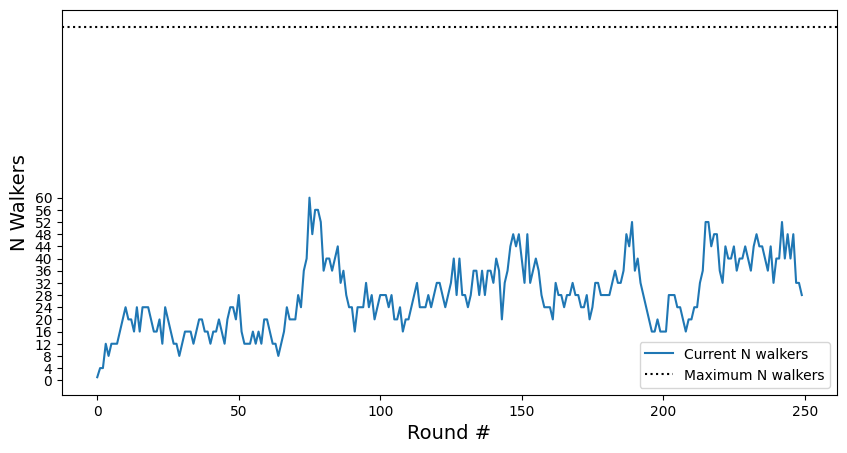
Total number of walkers in each round#
# plot total number of walkers (==parallel simulations) in each round
fig, axs = plt.subplots(figsize=(10,5))

n_walkers_per_round = [len(step_h) for step_h in we_sampler.history]

axs.plot(n_walkers_per_round, label="Current N walkers")
axs.set_yticks(range(0, max(n_walkers_per_round) + 1, we_sampler.n_traj_target))
axs.axhline(we_sampler.n_traj_target * we_sampler.n_bins, ls=":", color="k", label="Maximum N walkers")
axs.set_ylabel("N Walkers", size=14)
axs.set_xlabel("Round #", size=14)
plt.legend();
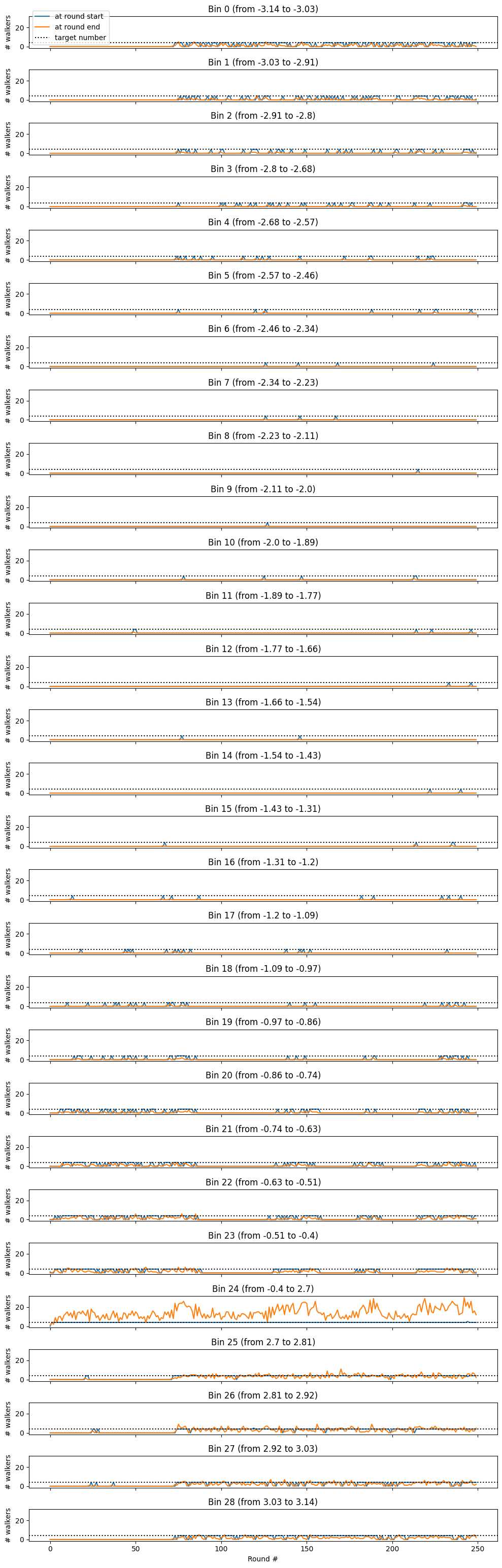
Number of walkers per bin in each round#
# get the number of walkers (==parallel simulations) for each bin separately
# make a history array
trajs_by_bin_start = np.zeros((len(we_sampler.history), we_sampler.n_bins))  # in which bin is the first frame of the traj
trajs_by_bin_end = np.zeros((len(we_sampler.history), we_sampler.n_bins))  # in which bin is the last frame of the traj

# and fill it
for step_num, step_history in enumerate(we_sampler.history):
    for result in step_history:
        # get all bin idxs the traj has visited
        bin_idxs = await we_sampler.get_bin_idxs_for_traj(result["traj"])
        # use the first frame (as it was the bin we started in)
        trajs_by_bin_start[step_num, bin_idxs[0]] += 1
        # use the last frame (as the bin we ended in)
        trajs_by_bin_end[step_num, bin_idxs[-1]] += 1
# plot it
fig, axs = plt.subplots(we_sampler.n_bins, sharex=True, figsize=(10, round(n_bins * 1.25)), sharey=True)

for bin_idx in range(we_sampler.n_bins):
    ax = axs[bin_idx]
    n_walker_per_bin_start = trajs_by_bin_start[:, bin_idx]
    n_walker_per_bin_end = trajs_by_bin_end[:, bin_idx]
    ax.plot(n_walker_per_bin_start, label="at round start")
    ax.plot(n_walker_per_bin_end, label="at round end")
    ax.axhline(we_sampler.n_traj_target, ls=":", color="k", label="target number")
    if bin_idx == 0:
        # plot the legend
        ax.legend()
    ax.set_ylabel("# walkers")
    ax.set_title(f"Bin {bin_idx} (from {round(we_sampler.bin_edges[bin_idx], 2)} to {round(we_sampler.bin_edges[bin_idx + 1], 2)})")
ax.set_xlabel("Round #")

fig.tight_layout()
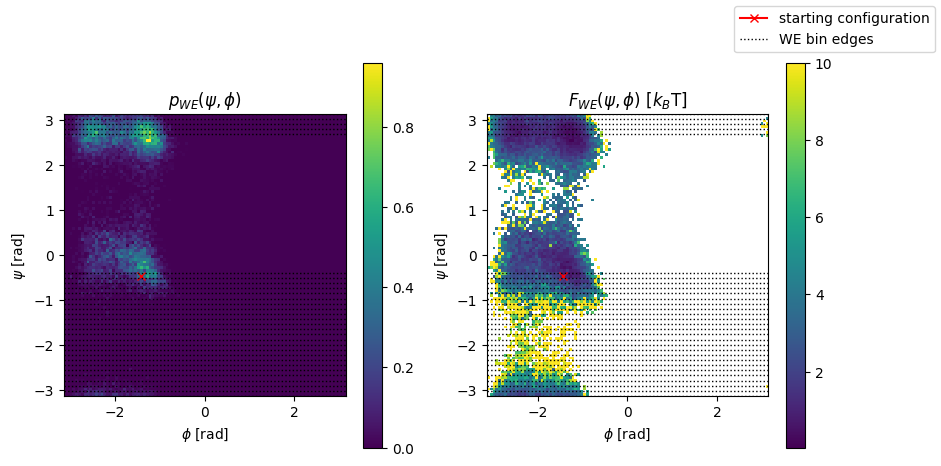
Probability density and free energy in \(\phi\)/\(\psi\)-plane#
# collect all trajs psi and phi values
all_traj_psi_phi = []
# and all weights
all_weights = []

for step_num, step_history in enumerate(we_sampler.history):
    for result in step_history:
        all_traj_psi_phi += [await wrapped_psi_phi(result["traj"])]
        all_weights += [np.full((all_traj_psi_phi[-1].shape[0],), result["weight"])]

all_weights_arr = np.concatenate(all_weights, axis=0)
all_traj_psi_phi_arr = np.concatenate(all_traj_psi_phi, axis=0)
# get ψ/φ-values for starting configuration so we can plot it
psi_phi_initial = (await wrapped_psi_phi(starting_configuration))[0]
# plot histogram of psi/phi values with correct trajectory weights
fig, axs = plt.subplots(ncols=2, figsize=(10, 5))

h, xedges, yedges = np.histogram2d(x=all_traj_psi_phi_arr[:, 1],
                                   y=all_traj_psi_phi_arr[:, 0],
                                   weights=all_weights_arr,
                                   bins=100,
                                   range=[[-np.pi, np.pi], [-np.pi, np.pi]],
                                   density=True,
                                   )

with np.errstate(divide="ignore"):
    F_we = -np.log(h.T)


for i, ax in enumerate(axs):
    if i == 0:
        image = ax.imshow(h.T, origin="lower", extent=[-np.pi, np.pi, -np.pi, np.pi], interpolation="none")
        ax.set_title(r"$p_{WE}(\psi, \phi)$")
    elif i == 1:
        image = ax.imshow(F_we, origin="lower", extent=[-np.pi, np.pi, -np.pi, np.pi], vmax=10, interpolation="none")
        ax.set_title(r"$F_{WE}(\psi, \phi)$ [$k_B$T]")
    sc_line, = ax.plot(psi_phi_initial[1], psi_phi_initial[0], marker="x", color="red", label="starting configuration")
    for edge in we_sampler.bin_edges:
        bin_line = ax.axhline(y=edge, ls=":", color="k", lw=1, label="WE bin edges")
    ax.set_ylabel(r"$\psi$ [rad]")
    ax.set_xlabel(r"$\phi$ [rad]")
    ax.set_aspect("equal")
    fig.colorbar(image, ax=ax)
fig.legend(handles=[sc_line, bin_line]);
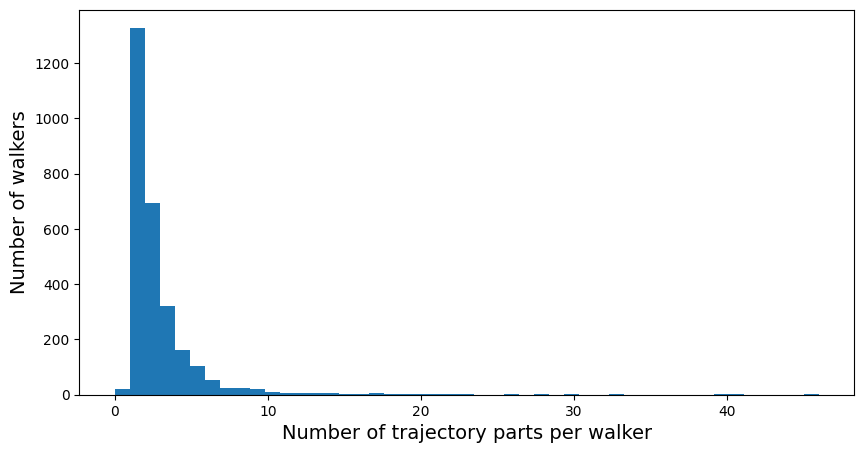
Number of consecutive trajectory parts per walker before it gets pruned#
# get statistics on how many rounds each WE_walker did
n_parts_by_walker = {}
for walker_id, walker in we_sampler.walkers.items():
    n_parts_by_walker[walker_id] = len(walker.trajectories)

# make a list for plotting
n_parts_list = [n_parts for n_parts in n_parts_by_walker.values()]
fig, axs = plt.subplots(figsize=(10,5))

axs.hist(n_parts_list, bins=max(n_parts_list) + 1)
axs.set_xlabel("Number of trajectory parts per walker", size=14)
axs.set_ylabel("Number of walkers", size=14)
Text(0, 0.5, 'Number of walkers')
Compare weighted ensemble to an equilibrium simulation with the same number of integration steps as all the walkers combined#
This is mostly to see if the weighted ensemble simulation was/is more efficient than a brute force integration in terms of integration steps.
While we also check and compare the total walltime each of the simulations run in this notebook, these numbers have to be interpreted with care: By running on a single workstation the weighted ensemble simulations are competing for the same resources and can run longer than if we run a single simulation with the same number of steps.
In addition the repeated re-initialization of the MD runs results in some overhead such as that the input configurations and MD parameters need to written out or the setup and autotune phase of gromacs.
However, this overhead becomes much smaller in comparison to the computation for larger molecular systems.
In addition, the weighted ensemble simulation is trivially parallelizeable over multiple nodes of a supercomputer, such that the weighted ensemble will most likely finish in a (much) shorter walltime than the equilibrium simulation in all production settings.
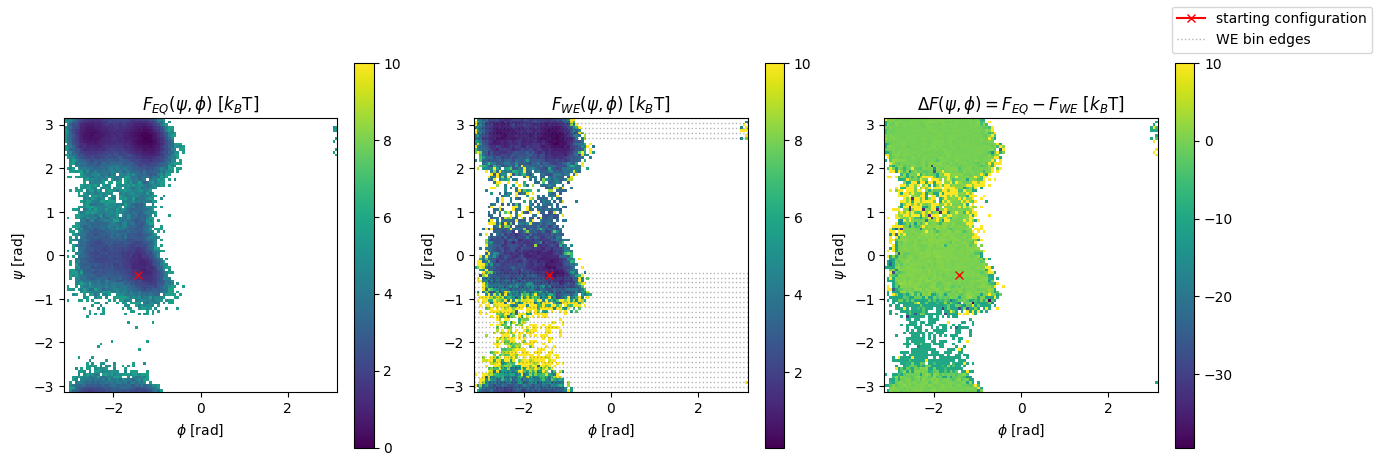
Furthermore, as the sampling of the region of the transition over the high barrier along \(\psi\) shows, the use of enhanced sampling can enable visiting regions that are rarely visited even on equilibrium trajectories of much greater length.
It is left as an exercise for the reader to use the run_walltime method of the GmxEngine to produce a long equilibrium trajectory with the same walltime as the weighted ensemble run and compare the two.
Note:
We are enhancing the sampling only along the chosen progress coordinate, i.e. \(\psi\), and especially only in the region where our bins are adequately placed and spaced.
This means that transitions along \(\phi\) are not enhanced by the sampling per se, but happen entirely random.
It can therefore still happen that you observe a transition over the high barrier along \(\phi\) towards \(\phi > 0\) in the equilibrium trajectory, which is not present in the weighted ensemble run.
Although, as noted above, since the states with \(\phi > 0\) are more accessible from states with \(\psi > 0\), they should be slightly more frequent in the weighted ensemble run if the bins are concentrated in \(\psi > 0\).
However, in any case you should see that the transition region over the lower barrier along \(\psi\) (in the region \(0.5 < \psi < 2\)) is resolved better in the weighted ensemble run than on the equilibrium trajectory (as long as most of the bins in the weighted ensemble run are placed in that region).
Especially the high(er) free energy bins in that region should be resolved much better in the weighted ensemble run.
That is, the usual caveat of CV-based enhanced sampling applies also to the weighted ensemble method: If your progress coordinate is not related to the transition you want to enhance or focusses sampling in the region you want your system to visit, enhanced sampling along this coordinate does not increase the frequency of the desired event.
To see the effect of this in action, try rerunning this notebook but this time focusing the computation on the region of the lower barrier along \(\psi\) (around \(0 < \psi < 2\)) by changing where the bins are concentrated.
To get you going the cell in which we setup the weighted ensemble sampler already contains proposed settings (bin_edges, n_bins, etc.) to sample the lower barrier along \(\psi\).
After uncommenting them and rerunning the notebook, you should see that now the weighted ensemble run is sampling the transition over the lower barrier more frequently than the equilibrium trajectory (albeit at the cost of now sampling less in the region of the higher barrier).
Create and prepare equilibrium engine#
# Use as many threads as possible for the EQ run as here we only run one parallel
engine_kwargs_eq = engine_kwargs.copy()
engine_kwargs_eq["mdrun_extra_args"] = "-nt 10" # domain decomposition fails if nt is too high

eq_engine = asyncgmx.GmxEngine(**engine_kwargs_eq)
# get number of steps we did in total in all walkers combined
n_steps_eq = n_steps_per_round * np.sum([len(step_h) for step_h in we_sampler.history])
print(f"all walkers did {n_steps_eq} combined integration steps")

# prepare the engine
dirname = os.path.join(working_directory, "long_eq_sim")
os.mkdir(dirname)
# use the same starting configuration as for the WE
await eq_engine.prepare(starting_configuration=starting_configuration, workdir=dirname, deffnm="long_eq")
all walkers did 3470500 combined integration steps
Run equilibrium engine#
t_start = time.time()
long_eq_traj = await eq_engine.run_steps(nsteps=n_steps_eq, steps_per_part=True)
t_end = time.time()
print(f"running long equilibrium trajectory took {round((t_end-t_start)/60, 2)} minutes.")
running long equilibrium trajectory took 17.57 minutes.
Calculate CV values for equilibrium trajectory#
This should be included in the total walltime for the equilibrium simulation as the weighted ensemble calculates these during the simulation to perform split and prune operations.
t_start = time.time()
long_eq_traj_psi_phi = await wrapped_psi_phi(long_eq_traj)
t_end = time.time()
print(f"calculating psi, phi for long equilibrium trajectory took {round((t_end-t_start)/60, 2)} minutes.")
calculating psi, phi for long equilibrium trajectory took 0.21 minutes.
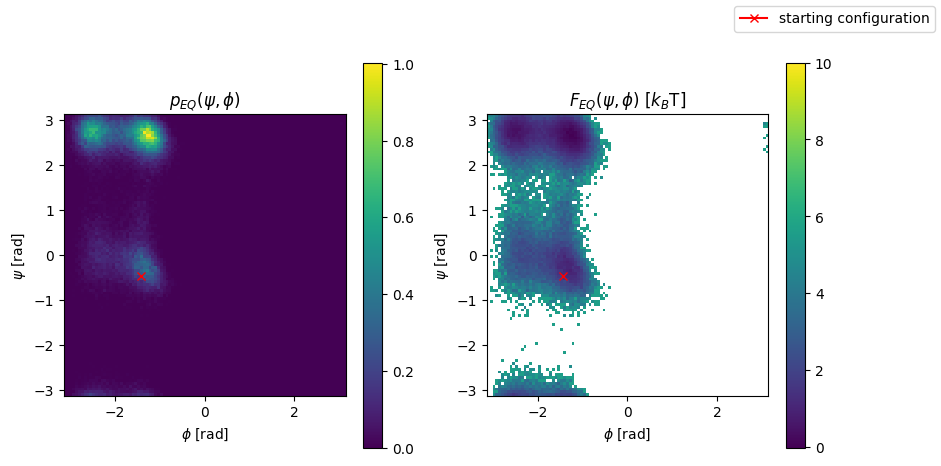
Probability density and free energy in \(\phi\)/\(\psi\)-plane from equilibrium simulation#
fig, axs = plt.subplots(ncols=2, figsize=(10, 5))

h_eq, xedges, yedges = np.histogram2d(x=long_eq_traj_psi_phi[:, 1],
                                   y=long_eq_traj_psi_phi[:, 0],
                                   bins=100,
                                   range=[[-np.pi, np.pi], [-np.pi, np.pi]],
                                   density=True,
                                   )

with np.errstate(divide="ignore"):
    F_eq = -np.log(h_eq.T)

for i, ax in enumerate(axs):
    if i == 0:
        image = ax.imshow(h_eq.T, origin="lower", extent=[-np.pi, np.pi, -np.pi, np.pi], interpolation="none")
        ax.set_title(r"$p_{EQ}(\psi, \phi)$")
    elif i == 1:
        image = ax.imshow(F_eq, origin="lower", extent=[-np.pi, np.pi, -np.pi, np.pi], vmax=10, interpolation="none")
        ax.set_title(r"$F_{EQ}(\psi, \phi)$ [$k_B$T]")
    sc_line, = ax.plot(psi_phi_initial[1], psi_phi_initial[0], marker="x", color="red", label="starting configuration")
    ax.set_ylabel(r"$\psi$ [rad]")
    ax.set_xlabel(r"$\phi$ [rad]")
    ax.set_aspect("equal")
    fig.colorbar(image, ax=ax)
fig.legend(handles=[sc_line]);
Compare probability density and free energy in \(\phi\)/\(\psi\)-plane between equilibrium simulation and weighted ensemble#
Bins visited by the equilibrium trajectory but not by the weighted ensemble will be set to 10 (and should show up as high values), while bins visited by the weighted ensemble run but not in the equilibrium trajectory will be set to -10 (and should show up as low values).
fig, axs = plt.subplots(ncols=3, figsize=(15, 5))


with np.errstate(divide="ignore", invalid="ignore"):
    F_eq = -np.log(h_eq.T)
    F_we = -np.log(h.T)
    DF = F_eq - F_we


for i, ax in enumerate(axs):
    if i == 0:
        image = ax.imshow(F_eq, origin="lower", extent=[-np.pi, np.pi, -np.pi, np.pi], vmax=10,
                          interpolation="none")
        ax.set_title(r"$F_{EQ}(\psi, \phi)$ [$k_B$T]")
    elif i == 1:
        image = ax.imshow(F_we, origin="lower", extent=[-np.pi, np.pi, -np.pi, np.pi], vmax=10,
                          interpolation="none")
        for edge in we_sampler.bin_edges:
            bin_line = ax.axhline(y=edge, ls=":", color="k", lw=1, label="WE bin edges", alpha=0.3)
        ax.set_title(r"$F_{WE}(\psi, \phi)$ [$k_B$T]")
    elif i == 2:
        DF[np.isinf(F_eq) & np.isinf(F_we)] = np.inf
        DF[np.isinf(F_eq) & np.isfinite(F_we)] = -10
        DF[np.isfinite(F_eq) & np.isinf(F_we)] = 10
        image = ax.imshow(DF, origin="lower", extent=[-np.pi, np.pi, -np.pi, np.pi], interpolation="none")
        ax.set_title(r"$\Delta F(\psi, \phi)=F_{EQ} - F_{WE}$ [$k_B$T]")
    sc_line, = ax.plot(psi_phi_initial[1], psi_phi_initial[0], marker="x", color="red", label="starting configuration")
    ax.set_ylabel(r"$\psi$ [rad]")
    ax.set_xlabel(r"$\phi$ [rad]")
    ax.set_aspect("equal")
    fig.colorbar(image, ax=ax)
fig.legend(handles=[sc_line, bin_line]);